



Beskrivning
Om boken
This is an introductory textbook of linear programming, written mainly for students of computer science and mathematics. Our guiding phrase is, ”what every theoretical computer scientist should know about linear programming”. The book is relatively concise, in order to allow the reader to focus on the basic ideas. For a number of topics commonly appearing in thicker books on the subject, we were seriously tempted to add them to the main text, but we decided to present them only very brie?y in a separate glossary. At the same time, we aim at covering the main results with complete proofs and in su?cient detail, in a way ready for presentation in class. One of the main focuses is applications of linear programming, both in practice and in theory. Linear programming has become an extremely ?- ible tool in theoretical computer science and in mathematics. While many of the ?nest modern applications are much too complicated to be included in an introductory text, we hope to communicatesome of the ?avor (and excitement) of such applications on simpler examples.
Åtkomstkoder och digitalt tilläggsmaterial garanteras inte med begagnade böcker
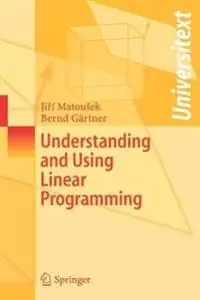
Mer om Understanding and using linear programming (2007)
2007 släpptes boken Understanding and using linear programming skriven av Jiří Matoušek. Den är skriven på engelska och består av 226 sidor. Förlaget bakom boken är Springer.
Köp boken Understanding and using linear programming på we och spara uppåt26% jämfört med lägsta nypris hos bokhandeln.
Tillhör kategorierna
ÖvrigtÖvrigt
Referera till Understanding and using linear programming
Harvard
Matoušek, J. (2007). Understanding and using linear programming. Springer.
Relaterade produkter
-
Rea!
Social change, development, and dependency : modernity, colonialism and the development of the West
Det ursprungliga priset var: 209,00 kr.83,60 krDet nuvarande priset är: 83,60 kr. Lägg till i varukorg -
Rea!
Programming in ANSI C
Det ursprungliga priset var: 165,00 kr.66,00 krDet nuvarande priset är: 66,00 kr. Lägg till i varukorg -
Rea!
Thinking from A to Z
Det ursprungliga priset var: 259,00 kr.103,60 krDet nuvarande priset är: 103,60 kr. Lägg till i varukorg -
Rea!
The surrender experiment : my journey into life’s perfection
Det ursprungliga priset var: 165,00 kr.66,00 krDet nuvarande priset är: 66,00 kr. Lägg till i varukorg